How animal shelters and rescues can succeed on Instagram
A practical guide to using Instagram to engage and grow your audience, leading to more adoptions, donations and support
Published September 29, 2026
“These are the kind of chickens you WANT in your group chat. The kind that blows up your phone at 5:42 a.m. with absolutely no regard for boundaries, and somehow, you still open every message.”
So began an Instagram post from the Humane Society of the Pikes Peak Region in Colorado, with photos of five adoptable roosters and the “group chat persona” of each. (“Chicken is the self-appointed leader. No election. No discussion. Just vibes and authority.”)
When a commenter checked in on the flock a week later (“Never been so invested in a group chat. Need an update about what is going on!!”), the shelter had good news to share: “The Rooster Group Chat has officially gone inactive…because every single member was adopted! The end of an era.”
It was the kind of playful humor that Colette Bradley, the shelter’s director of marketing and communications, has found resonates on Instagram and drives real results for animals—even famously hard-to-adopt roosters.
“We’re here to have fun and not be so serious,” Bradley says. “On Instagram, our audience is millennial; they love humor, they love fun and they love carousels.”
Jokes aside, Instagram is serious business for shelters and rescues these days. Kaitlin Pechin, digital marketing manager at the Humane Society of Broward County in Florida, says her shelter raised nearly $100,000 through Instagram and Facebook in 2025.
“Social media has become one of the most powerful tools that our shelter has,” Pechin says, and “Instagram has become this app where we’re able to deepen our relationships and maintain our support with followers.”
Here, animal sheltering social media pros discuss what goes into success on Instagram, even for time-strapped teams, with minimal ruffled feathers.
“Social media has become one of the most powerful tools that our shelter has. Instagram has become this app where we’re able to deepen our relationships and maintain our support with followers.”
—Kaitlin Pechin, Humane Society of Broward County
Benefits of Instagram for animal shelters and rescues
First, why focus on Instagram?
Pechin says she posts the same content across Facebook, Instagram, YouTube and TikTok, but her shelter’s Instagram followers are “way more consistent”—as donors, adopters and content sharers—than its followers on other platforms.
Instagram nurtures her community in a unique way, Pechin adds, with features such as Stories and livestreams that make community members “feel like they’re here with us and they’re part of the story.”
That side of Instagram shares similarities with TikTok (both apps enable livestreams and authentic video sharing), but Bradley has found that Instagram draws a more local crowd. While the TikTok algorithm pulls in followers from all over the world, she says, her shelter’s Instagram followers mainly live near its facilities in Colorado Springs and Southern Colorado. “They see our content and can take action.”
Both Bradley and Pechin point to adoptions as the top action they get from their Instagram followers. The Broward County shelter, which adopts out close to 4,000 pets a year, recently polled adopters to see where they first learned about their pet: About 75% of respondents said social media.
And while most of its adopters are local, the shelter’s Instagram audience has grown so large and enthusiastic, with more than 500,000 followers and counting, that it has attracted adopters from beyond its South Florida community.
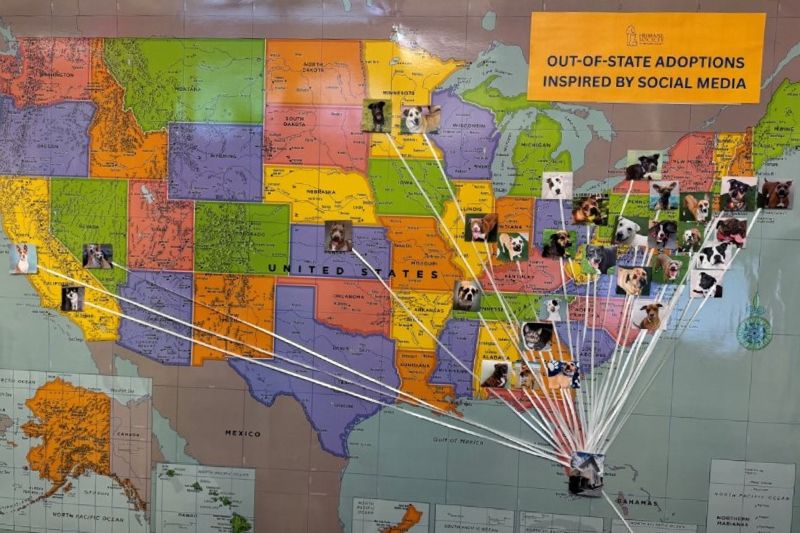
Pechin has a map of the United States behind her desk with dozens of photos of pets who have found homes with out-of-state adopters. One 3-year-old dog, Maddie, had been in the shelter for three months when her Instagram video caught the eye of an adopter in Maine. He flew down to meet her and then drove her back up north to her new home in Cape Cod.
Beyond adoptions, Pechin also uses Instagram for fundraising, event marketing, volunteer recruitment, attracting sponsorships and education. Ultimately, she says, it all adds up to turning “supporters who are watching you day-to-day into lifelong advocates.”
What animal shelter and rescue content works best on Instagram
Simple, authentic images
At its heart, Instagram is a visual platform. “You’re drawn in by the imagery first thing,” says Heidi Freestone, social media manager for HumanePro. And while that can include TikTok-style videos called Reels, Pechin says simple photos and groups of photos called carousels are winning hearts, minds and the Instagram algorithm lately.
For busy shelters, especially those that don’t have a dedicated social media person, “this is an exciting time to post images again and be rewarded for that,” Pechin says.
Even photos that are a bit blurry, or where the kennel is messy, can be a hit. At a time when AI-generated posts and videos are flooding the internet, “people are craving realness,” Pechin says. “So in the rescue and shelter world, we have a huge competitive advantage to provide this authentic content to them.”
Authenticity comes through in videos too. Her shelter has found success with unedited walk-throughs of their facility: walking down a row of kennels, showing the animals’ faces, showing the actual condition of the space. “We are lucky to have a beautiful facility that’s very well kept,” she says. “Some shelters may look more disheartening, but people still want to see it.”
Humor and trends
“Don’t be afraid to have a little fun and push the boundaries a little bit,” Bradley says. “It doesn’t have to be so buttoned-up. Animal welfare organizations should have a little fun. We’re in the business of bringing people and pets together.”
In one of the Pikes Peak shelter’s recent viral posts, Bradley’s team created a carousel of adoptable cat photos, with each cat sharing “dating advice.”
Under an orange kitten named Ban-A-Boomerang, the text reads: “If he has a sword collection, we are begging you to ask more questions before entering that home. Adopt Ban-A-Boomerang instead!”
A few people (namely, sword collectors) were offended by the joke, but the response—over 95,000 likes and 63,000 shares—was overwhelmingly positive.
“[Our Instagram audience] loves that humor and playfulness,” Bradley says. “And it really speaks to the younger millennial and elder Gen Z who’s still in that dating scene space.”
Freestone, who follows shelters and rescues all across the country on Instagram, says the top performers she sees are quick to jump on trends.
A case in point: Another popular post by Bradley’s team compared the shelter’s cats to Sex and the City characters. “Stevie is a Carrie (somehow the hot party girl despite being deeply weird).” “Penelope is a Miranda (judgmental, but usually right.)” “Fairweather Fred is a Samantha (radiates magnetic energy).”
The post was timed to the end of the Sex and the City sequel series, and TODAY picked it up.
Finding the right mix of content
Pechin suggests thinking carefully about the balance of happy and sad posts, and the unintended consequences of both. “We can’t create compassion fatigue for followers by only showing the sad stuff, and we can’t only show the happy stuff and look like we’re doing great and don’t need help,” she says.
She likes an 80/20 rule: 80% of her shelter’s posts are “real and raw and sometimes upsetting,” and 20% of posts show happy endings and adoptions. “That’s when you’re also asking for things, like adoptions or foster families or donations,” she says.
Since followers can become deeply invested in an animal’s story, follow-ups are also important. After posting an initial plea video for an animal, Pechin says, “I try my hardest to be able to film the adoption and the animal going home. Those videos also perform incredibly well. I mean, everybody likes to see a happy dog walking out the doors.”
“People are craving realness. So in the rescue and shelter world, we have a huge competitive advantage to provide this authentic content to them.”
—Kaitlin Pechin, Humane Society of Broward County
How to build and grow an Instagram following
The key to getting new followers and engaging your existing followers, Pechin says, is simply posting regularly on a predictable schedule.
“The goal I would set for someone is to post one thing every day, whether that’s a video or a still photo,” Pechin says. “We’ve seen major success in showing up daily.” But if daily isn’t realistic, “pick a cadence that works for you. If you know you can post twice a week, you need to be posting twice a week.”
If you’re starting a new account, it’s important to market it for growth by asking your staff, volunteers and community at large to follow along, Freestone says. “Make sure your social media channels are visible throughout your shelter and on marketing materials. You never know who you’ll reach by having a social media presence and the impact they can make by adopting, fostering or supporting your shelter in other ways.”
And as you keep posting, monitor what’s working and what’s not, and pivot accordingly.
“If we try something new and it doesn’t work, we won’t repeat it,” Bradley says. “We are watching mostly comments to see what they’re saying and responding to. When we realized they like cheeky content, we said, ‘Let’s do it. How can we make every post speak to a millennial woman? How can we bring that sarcastic humor in a little bit?’”
Bradley also looks at what content is getting shared, who’s sharing and their demographics, and the times of day that posts do best.
Pechin recommends looking for overall patterns with content that performs well, and then repeating those elements. That’s how she came up with a format for adoptable pet videos.
“Every time I start a video," she says, "if I put a sign that explains the animal’s story on the kennel cage, and I start on that then zoom to the pet, this will outperform a fully scripted, produced, beautifully edited Reel by over 150 times.”
How to fundraise on Instagram
Every six weeks, Pechin sets up a new fundraiser on Instagram, tied to a specific animal who needs help, such as medical care or transport. She’s found that fundraisers tied to an individual case invariably do better than general asks for funding.
“People want to feel that they’re part of this story,” she says.
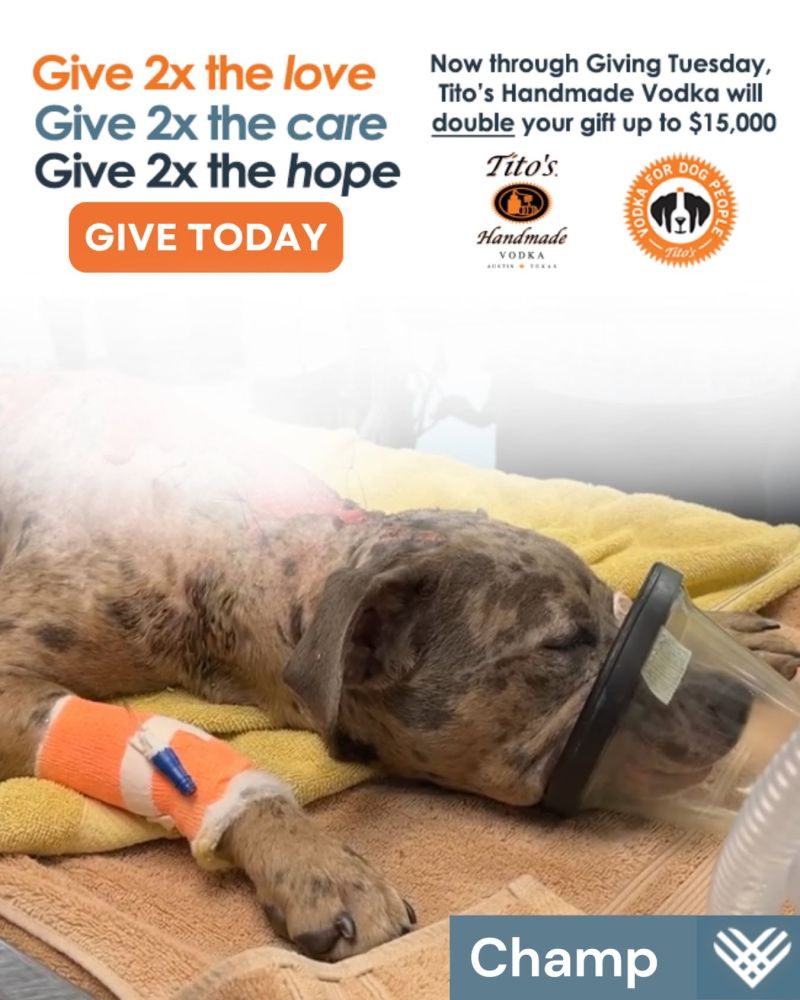
In one emergency situation, she posted about a dog named Champ who had suffered chemical burns all over his skin and needed cold laser therapy. So many donations came in that her shelter was able to purchase its own cold laser machine. “Now we use it for so many animals,” Pechin says.
Just don’t oversaturate all your posts with a fundraiser, she cautions. If you link to the fundraiser with every post, livestream and video, “people get burnt out and feel they’re seeing the same thing over and over again.”
To take a break from asking for money, Pechin occasionally posts a plea for towels or sheets or asks for treats, toys or other supplies from the shelter’s online wish lists.
“People are always prepared to show up in a way that feels tangible for them,” she says.
Tapping staff and volunteers for social media content
Bradley oversees all marketing and communications for Pikes Peak, with one employee on her team focused mainly on social media. Pechin is the sole social media staffer at the Broward County shelter. Both rely on their coworkers and volunteers to help keep them informed and provide content for their social media channels.
Bradley set up a few systems that make the internal coordination easier:
- A shared online folder where everyone can submit photos and videos with animal ID numbers. This enables Bradley and her team to easily look up animals in their system and follow their stories.
- A Bluetooth doorbell in the vet clinic. “When they have a cool story, they hit the doorbell and someone from our office comes running,” she says.
- Weekly half-hour meetings with key staff, such as communications, annual giving, behavior and field services teams. Regular meetings help her team learn about the work of other departments and share their stories.
Freestone, who fosters pets for the Iowa City Animal Care and Adoption Center, suggests encouraging foster caregivers to make their own Instagram posts, too.
For a foster dog named Poptart, Freestone recorded video of the pup playing in the snow, then turned it into an Instagram Reel with trending audio. Poptart was quickly adopted.
“You don’t need to have a major following to make an impact,” Freestone says, “and you never know who will see your Reel.”

Advertisement