How animal chaplains help shelter workers cope with moral distress
The emerging field of animal chaplaincy brings interfaith healing to animal welfare
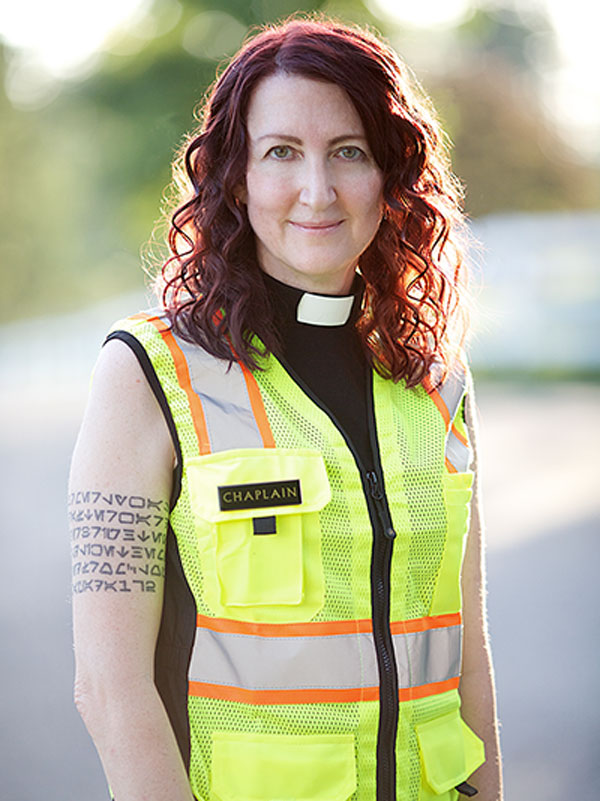
She was 6 years old, a Star Wars fan with the lunchbox to prove it, when walking home from school she came across a chipmunk who had been killed by a passing car. She used sticks to gently place the animal in her lunchbox to carry home, where she dug a small hole and officiated a proper send-off.
Her eulogy, perhaps not surprisingly, ended with “May the Force be with you.”
At the time, Sarah Bowen was unaware there was a name for what she was doing. She just knew animal lives mattered—and when they ended, some sort of ceremony should take place.
Over time, her backyard became the burial ground for countless small animals she found. A few decades later, she still stops when she sees a fallen animal. Instead of a lunchbox, she carries yellow emergency lights, tongs, a shovel, plastic gloves and a high-visibility vest.
Her words, though more expansive now, end the same way.
“From here, I hope you have a most auspicious next lifetime, if that is possible—and may the Force be with you.”
Bowen, an ordained minister and interfaith animal chaplain, is the co-founder of the Compassion Consortium, a spiritual community for people of all faiths (or no faith) who care about animals, and the driving force behind its Animal Chaplaincy Training Program.
She is also the author of Sacred Sendoffs: An Animal Chaplain’s Advice for Surviving Animal Loss, Making Life Meaningful & Healing the Planet, and she presented at the 2026 Animal Care Expo, where she discussed a new kind of support for some of the field’s oldest and heaviest problems.
Moral distress vs. compassion fatigue
Most animal welfare professionals are familiar with the term “compassion fatigue.” A 2023 study of U.S. shelter staff published in the Journal of Shelter Medicine and Community Animal Health found that more than half of respondents recorded burnout scores in the high range, and more than 90% recorded high levels of secondary traumatic stress.
But Bowen’s research—which examined shelter workers, veterinarians, wildlife rehabbers, conservationists and animal services officers—suggests the field has been misidentifying a significant part of the problem.
“What we have learned, and what my research shows, is that what’s often happening is being mislabeled as compassion fatigue,” Bowen says. “What we’re really having is moral stress, or moral distress.”
If you've ever felt like self-care advice missed the point entirely, moral distress might be the reason. Compassion fatigue is about emotional exhaustion. Moral distress is about something deeper: the gap between what you believe should happen and what actually does.
Hilary Hager, vice president of Outreach, Engagement and Training at Humane World for Animals, has been leading compassion fatigue workshops since 2007. She recognizes what Bowen is describing.
“There is this gap between what you were able to do and what could possibly be done if you had unlimited resources,” Hager says. “That’s where that pain comes in.” A connection to animals is what draws people to this work; it’s also what makes the losses so heavy.
Left unaddressed, moral distress can deepen into moral injury, Bowen says, meaning lasting damage from something repeatedly going against your deepest values. In a shelter context, that might look like years of euthanizing healthy animals due to overcrowding, or watching a policy take effect that you believe causes harm.
“When this happens and someone says, ‘How’s your self-care? Why don’t you take a few deep breaths?’ your response is probably going to be a few choice words,” Bowen says.
Instead, she adds, you need someone to listen (really listen) to the full story of what’s hurting you and help you find a recovery method that works.
That someone is an animal chaplain.
What does an animal chaplain do?
Animal chaplains provide emotional and sometimes spiritual support for people who care for animals and sometimes for the animals themselves, such as through blessing events or providing a comforting presence during euthanasia.
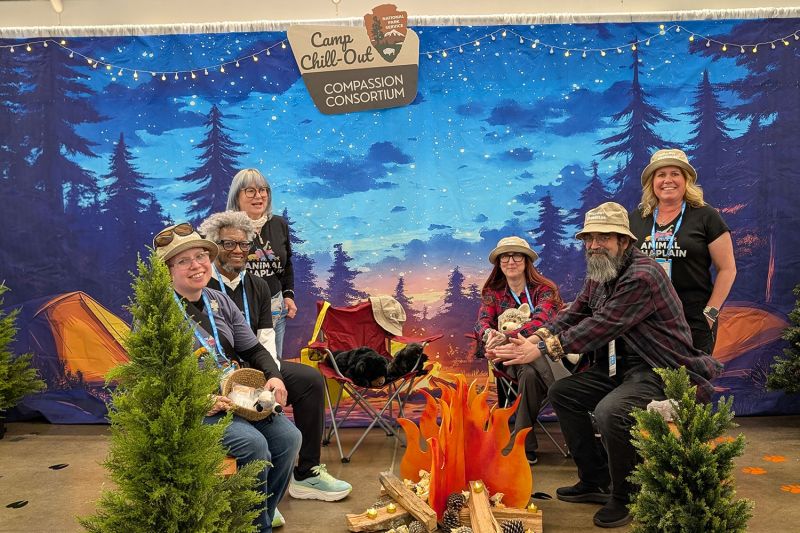
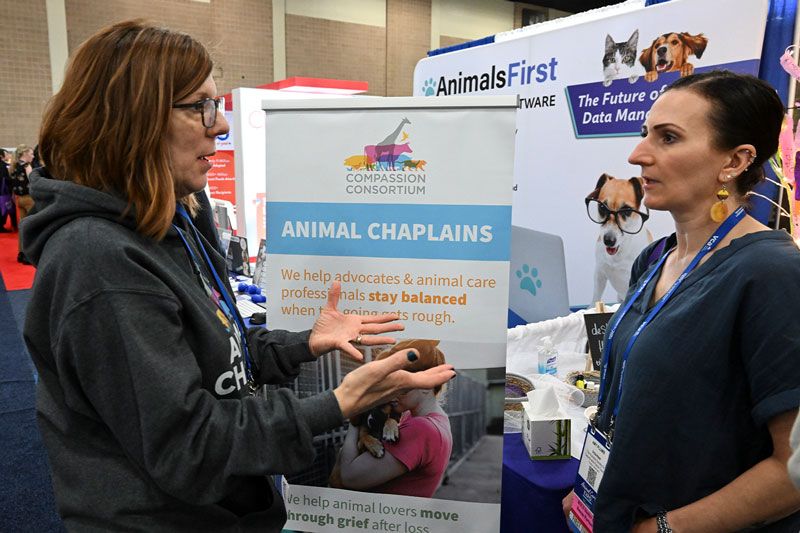
Bowen talked about the role with attendees at Animal Care Expo, where Compassion Consortium set up a cozy campsite booth with a faux campfire and camp chairs. People wandered in, sat down and started talking.
“What I see when people walk into our booth,” Bowen says, “is that my greatest gift [is] to be able to hold your stories as important and to listen.”
Animal chaplaincy can take many forms. Chaplains may offer one-on-one grief support, organize group sessions or create ritual practices that help workers transition between the weight of the workday and their home life.
“Routine is something we do without really thinking about it sometimes,” she says. “A ritual is something meant to honor someone or something that is meaningful to us.” (If “ritual” feels too religious, Bowen also uses “habitual,” a portmanteau of habit and ritual.)
These small, intentional acts interrupt the emotional numbing shelter workers often rely on to continue the work, day in and day out.
“We’re not ignoring what just happened,” Bowen says. “We’re not forcing strength, saying ‘I’m fine, let’s just keep going.’ You’re taking a moment to acknowledge that you have emotions about what’s going on, and you’re attending to them in a way that doesn’t get in the way of the work.”
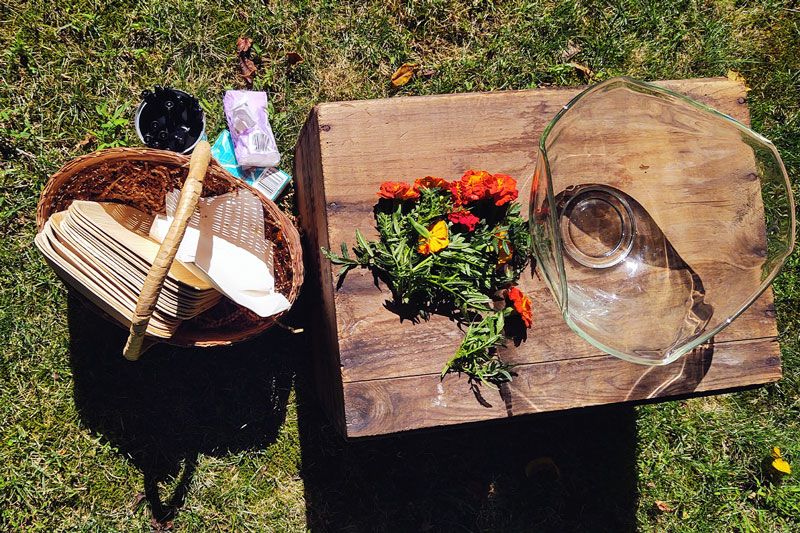
She recently helped staff and volunteers at a farm animal sanctuary grieve the loss of a goat killed by a vehicle on the grounds. Bowen invited everyone to write letters to the goat on dissolvable paper, then watch the words lift off the page as the paper dissolved in a bowl of water. They poured the water where the accident happened and hung wind chimes nearby. Some sheep wandered over to join the circle, Bowen says, prompting smiles from the mourners.
“We shared stories and laughed and cried,” she says, “until everyone felt like we had truly honored this beautiful being.”
Why animal chaplaincy is a growing field
A 2024 study published in the Journal of Religion and Health identified chaplains as holding an essential role in reducing healthcare workers’ moral distress, specifically because of their training in deep listening, crisis intervention and helping workers find resolutions that align with their own moral values.
While chaplaincy in animal welfare is relatively young compared to its role in healthcare, it’s quickly finding its way into established institutions. Washington State University’s College of Veterinary Medicine, for example, has a nondenominational veterinary chaplain.
The field’s growth coincides with an increasing recognition among shelters and other animal welfare organizations of the emotional toll of the work and the importance of workplace culture, Hager says.
After years of running compassion fatigue workshops, Hager has watched what happens when organizations treat staff wellness as an individual problem rather than a structural one.
“It doesn’t matter what kind of self-care you engage in if you’re swimming in a toxic stew,” she says. “The longer I’ve been doing this, the more responsibility I place on organizations to create the culture in which people are able to thrive.”
The cost of leaders expecting their staff to manage on their own, she warns, is often an exodus of qualified, well-trained staff.
“Eventually they get to a place where they can’t keep doing the work and they have to step away for their own hearts and their own well-being,” she says. “Turnovers like that affect our ability to keep the movement moving forward.”
Help is becoming easier to find, as more shelters enlist the aid of animal chaplains, veterinary social workers and similar professionals to support staff and organizational health. Some take it a step further by identifying someone on staff or in their volunteer network who feels called to this kind of support and send them through a chaplaincy training program.
“Our cohorts mirror the field,” Bowen says, with animal care and control officers, wildlife rehabbers, veterinarians, shelter workers, sanctuary workers, even dog walkers and vegan advocates.
The big “aha” at the end of the course, she says, is always some version of the same thing: “I had no idea that so many people could benefit from chaplain support.”
Space for healing
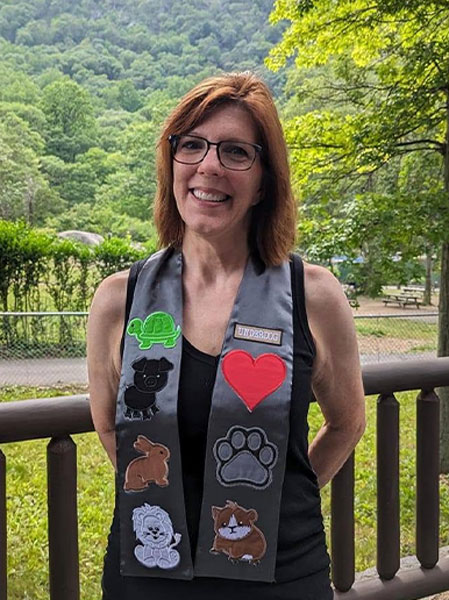
Years before she became an animal chaplain, Jill Angelo worked at a large open-admission shelter in the Chicago area, cycling through intake, medical checks, off-site adoptions and the hardest room of all.
In 2017, she founded The Moon Dog Farm, a Chicago-area nonprofit that fosters animals with special needs, specifically dogs, guinea pigs and rabbits. When she later met Bowen at a faith conference in Toronto, Angelo shared that she was looking for a way to blend her spiritual life and her rescue work. Bowen said she was developing something, but it wasn’t ready yet.
“Then fine,” Angelo told her. “I’ll wait.”
Angelo kept rescuing animals in the meantime, and when Bowen’s Animal Chaplaincy Training Program opened in 2022, Angelo was among the first to sign up. The nine-month program includes online classes that cover chaplaincy, grief fundamentals, animal theology, human-animal relationships and nature spirituality. Angelo was ordained in its inaugural cohort in 2023.
When she’s invited into a shelter to offer chaplaincy support, she brings her experience from the sheltering world and her spiritual training. She also carries a toolkit with Rescue Remedy (liquid drops and lozenges made from Bach flower essences to relieve stress) shelter staff can take on the spot, organic lavender tea and handmade bath bombs for them to take home, heart-shaped rose quartz stones for something textured to hold, and nuts and crackers for a boost of energy.
She’s available to anyone who would like to talk, and she tailors her response to their needs.
To give staff a safe place to decompress, Angelo recently turned a donated bus into a mobile wellness space. She named it Underdog, tying in with The Moon Dog Farm’s tagline of “Love the Underdogs.” It’s decorated with neutral colors, soft textures and a ceiling hatch covered by a flag that reads: This is a safe space to be who you are.
The idea for the bus came from a conversation with shelter staff who said they needed a place to step outside of the building and breathe.
“My sincere hope,” Angelo says, “is that they are going to know they are heard and seen.”
“You’re taking a moment to acknowledge that you have emotions about what’s going on, and you’re attending to them in a way that doesn’t get in the way of the work.”
—The Rev. Sarah Bowen, co-founder, Compassion Consortium
Is this a religious thing?
Angelo and Bowen get this question often. The short answer: no.
“When a chaplain comes into your organization, they’re not bringing any religious beliefs, nor are they teaching anything religious,” Bowen says. “But they are capable of understanding if someone in your organization has religious issues they want to talk about.”
Chaplains work with a wide variety of faiths and, as Bowen puts it, “fierce atheists.”
Angelo echoes this from the field. Religion of any sort is not at the forefront when she walks into a shelter, she says. Her animal chaplain sweatshirt and Stanley mug with The Moon Dog Farm logo tell people who she is. Her willingness to listen does the rest.
“I’m not talking at people,” she says. “I’m being with them.”
Angelo does animal blessings around the Feast of St. Francis and prays with those who find it meaningful. And she offers a listening ear and secular words of support for those who prefer that.
She’s trained to meet people wherever they are.
A closing thought
On the way home from a long day, if you happen to pass a fallen animal on the side of the road, Bowen would like you to know that it’s OK to say a few words. It’s OK to feel the weight of it.
May the Force be you.

Advertisement