Fact sheet: What to do about opossums
How to coexist with the United States' only backyard marsupial
Published August 26, 2026
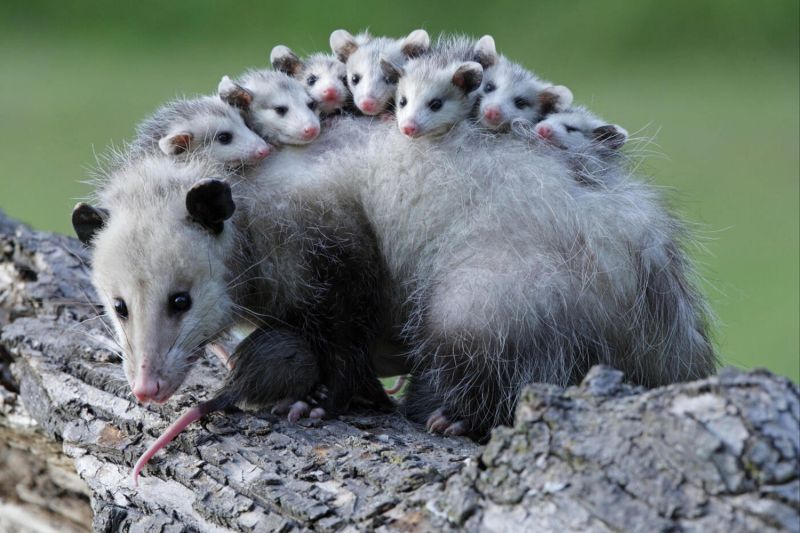
Opossums are shy, nonaggressive creatures who have the misfortune of scaring people due to their rather odd appearance. Their open-mouth, defensive hissing is merely a bluff to look vicious, and if that doesn't work, they play dead (when really scared)!
Opossums are very beneficial animals, providing free pest control by eating things some people don't like, such as insects, snails, slugs, and small snakes and rodents. They'll even clean up spilled garbage and fruit that has fallen off trees. If there's an opossum in the area, don't worry, they're not a threat and more than likely will be moving on in a short while.
Opossum on lawn or in tree
This is normal behavior, not cause for alarm. Opossums are typically active at dawn and dusk but can be seen at any time. They're not looking to attack or bother anyone; they're actually very harmless creatures (despite their scary looks!).
Opossum in a window well
Put a 3-inch-thick branch or two-by-four board in the window well so the opossum can climb out. Rest assured, the opossum won't jump up and attack! Be sure to get a window well cover (inexpensive from home building stores) after the opossum is gone or this problem may happen again.
Opossum eating garbage
Like most wildlife, opossums will take advantage of open or spilled garbage containers, so the solution is better containment. Secure trash lids with bungee cords or get an Animal Stopper brand trash can (which has built-in bungee cords). Put the garbage out the morning of trash pickup or get an outdoor storage enclosure for trash cans from a home building store. Trapping won't solve the problem; as long as there's a food source, animals will return to it.
Opossum in trash can
Opossums, attracted by the smell of food, can get stuck inside trash cans from which they can't climb out. To get the opossum out of the trash can, slowly tip the can on its side; the opossum will come out when ready. (They don't move when scared, so it may take a while; they'll need some space and privacy to come out on their own.) A broom can be used to gently tip the trash can over if needed. After the opossum has left, get a secure lid for the trash can (or use bungee cords or get the Animal Stopper brand trash can) so the problem doesn't recur.
Opossum in garage or home
Opossums may wander into garages if the door is left open. Remove access to food, birdseed bags or trash. Then open the garage door before dusk, sprinkle an 8-inch band of white flour under it and watch for exiting footprints. Shut the door once the animal leaves. Every now and then, an opossum will get into a house through a pet door. Encourage the opossum to leave by closing the doors to all rooms and opening the doors to the outside. Opossums are rarely aggressive, so you should be able to help them on their way by gently nudging them with a broom.
Opossum under deck/shed
No need to do anything. Opossums are nomadic and will leave on their own very soon. They're gentle and nonaggressive animals who will not attack anyone. If necessary, the deck or shed can be sealed off using an L-shape barrier design, but it's critical not to entrap animals or separate parents from babies, who will starve without them. (Note that there may be other wildlife using the deck or shed.) Seal off the deck with mesh while leaving one exit hole and putting a one-way door (or animal excluder available from Tomahawk Live Trap Co.) over that hole so the opossum can leave but not return. Leave the door in place for at least three days. Never use mothballs or ammonia to harass wildlife, as the chemicals are harmful to both humans and animals.
Baby opossum alone
Baby opossums stay in their mother's pouch until they're about 2.5 months old and the size of a mouse. At this age, they ride on mom's back and can sometimes fall off without her noticing. If the baby opossum is less than 7 inches long (not including the tail), they're too young to be on their own, and you should contact a wildlife rehabilitator. If the baby's body length is longer than 7 inches (not including the tail), then they're big enough to survive on their own.
A "rabid" opossum
Surprisingly, opossums rarely, if ever, get rabies. If the opossum is hissing, drooling, swaying or opening their mouth really wide (so you can see all 50 teeth), they're just doing a bluff routine to scare you or a dog off. What you're seeing is normal defensive behavior. Move away or bring in pets for a little while, and the opossum will leave once they realize that the threat is gone.
Dead opossum
If a clearly dead opossum is found in late spring or summer, and if it's safe to do so, check whether there are any surviving babies in her pouch who need to be detached. Gently nudge her with a stick to see if there's movement in the pouch. Because the babies are born as embryos, as many as 13 may be in the mother's pouch nursing. They can be difficult to detach from her teats but can be gently "unscrewed." The babies should immediately be taken to a wildlife rehabilitator. Another possibility is that the opossum is just playing dead, which is a defense mechanism they use to protect themselves from predators. When an opossum is playing dead, no amount of disturbance (loud noise included) will get them to move until they're ready! If it's unclear whether an opossum is dead or playing dead, leave the area for an hour and check back to see if the animal is gone.
Document

Advertisement