Fact sheet: Helping turtles safely cross roads
Tips for what you can do if you see a turtle crossing a road
Published August 18, 2026
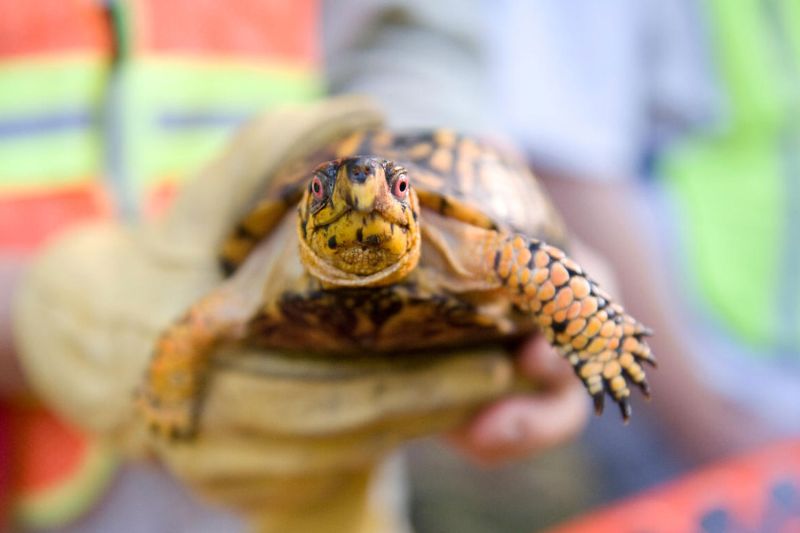
Turtles travel to find mates, nesting sites and new habitat, and in response to seasonal conditions such as drought. During nesting season, females often cross roads to reach sunny, sandy places to lay their eggs, putting them at high risk of being struck by vehicles.
Here are tips for what you can do if you see a turtle crossing a road.
Safety first
Always keep your own and others' safety in mind when attempting to help any animal. Take stock of your surroundings, stay calm and avoid sudden movement that disrupts traffic or puts you or others at risk.
- Is it safe to pull over?
- Is it safe to get out of the vehicle and on the roadway?
- Make use of your hazard lights and signal appropriately to pull off the road and when pulling back into traffic.
- Watch for oncoming vehicles.
Intervene only if needed
The best way to help a turtle cross a road is to keep humans, pets and vehicles at bay until the turtle can safely cross on their own. If the turtle is moving from one side of the road to the other and can do so safely, keep watch from a distance.
Turtles are long-lived animals who take many years to reach reproductive age, often 10-15 years. Their delayed maturity coupled with low hatching success means that the annual loss of just a few adults to roadkill can lead to a significant local population decline.
If the turtle needs assistance
Be very careful when moving a turtle. They could be injured or, depending on species, could bite you.
Handling most turtles
The safest way to pick up most turtles is by holding the shell near the rear but away from the back legs to avoid being scratched. Grasp them firmly on both sides of the body, in front of their hind legs. Be careful not to drop them. Do not pick up by tail or limbs; this can seriously injure the turtle.
Handling snapping and softshell turtles
Snapping and softshell turtles are particularly defensive on land and will attempt to bite you. For turtles, we recommend using the low contact method (see below).
Never hold them by the side of their shell. This is too close to their mouth, and you can be seriously injured. Snapping and softshell turtles have very long necks and can bite your hands if you place them at the sides of the shell.
Do not pick up snapping turtles by the tail. Their vertebrae (or spine) are fused to the underside of their shell. If you pick them up by their tail, you will injure their spine.
Platter method: The platter method is a hand-carry technique that keeps your hands out of reach by holding the turtle away from their head and legs. Do not use this method for large snapping or softshell turtles, who may be too heavy or have necks flexible enough to reach and bite.
- Approach from the back.
- Keep your hands on the back third of the turtle's body, with one hand laid flat under the plastron (bottom shell) to support the turtle's weight.
- Use your other hand to stabilize the turtle by gripping the back of the carapace (upper portion of the shell). Lift carefully and keep the turtle low to the ground. This ensures you do not hurt them if you lose your grip.
Low-contact method: This method is particularly useful for large turtles. Slide a car mat under the back of the turtle, then grab the back of the turtle's shell along with the mat and drag the turtle across the road to safety. Check out the Toronto Zoo's "How to help a snapping turtle cross the road" video.
Another option is to use a snow shovel or piece of plywood to gently lift and move turtles off the road. These tools can help support and shepherd turtles and other animals off the road, but you may need assistance if you lack experience or strength.
Always move in the direction of travel
Always move the turtle in the direction they were heading. Never turn them around, even if it appears they are moving away from water. When turtles are on the move, they are heading toward a specific destination within their home range. If turned around, they may try to cross the road again after you leave. Turtles who cannot return to familiar territory may stop eating and wander, increasing their risk of harm.
Carry the turtle just off the shoulder of the roadway, far enough to be safe from traffic. Don't relocate a turtle to a place you think is more suitable. Trust their turtle instincts, not your judgment of the terrain.
If the turtle is in an obviously hazardous area, such as a busy parking lot, move them to the nearest spot that is out of harm's way and in the same direction that they were traveling.
After moving the turtle
Once the turtle is safe on the other side, leave them alone.
Always wash your hands thoroughly after handling a turtle. Turtles can carry bacteria (e.g., salmonella) that aren't harmful to them but may cause health issues for humans.
Document

Advertisement