Fact sheet: What to do about skunks
A gentle species rarely worth raising a stink over
Published November 10, 2026
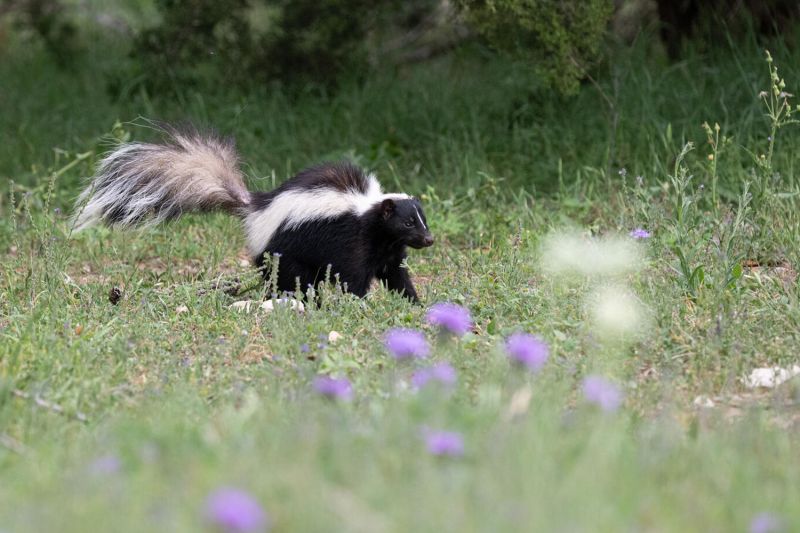
Skunks are shy, nonaggressive animals who would much rather avoid a confrontation than start one. Spraying is a last resort, not a first move. Skunks about to spray will stomp their feet and raise their tails to warn you first. If you see these signs, simply back away slowly and speak in a soft voice, and the skunk will move along.
As true omnivores, skunks provide excellent free pest control, digging for grubs and eating insects, mice and other small animals many homeowners consider pests, along with the occasional bit of fruit or garden produce. Weighing just 4 to 10 pounds, these adaptable animals can thrive in open fields, woods, and suburban or urban neighborhoods.
Although skunks are mostly active at night, seeing one during the day is not unusual or, by itself, a cause for concern. In suburbs and cities, where food, water and safe den sites are readily available, skunks typically spend their lives within a range of just a few blocks. They frequently move between temporary dens under sheds, decks, porches, woodpiles or dense vegetation, usually staying in one location for only a few days. The exception is a mother raising her young, who may remain in the same den from late spring through summer until her kits are old enough to travel with her (around 6-8 weeks old).
Skunks are also nearsighted and have poor eyesight in general, relying more on their sense of smell and hearing. Objects appear out of focus unless right in front of them, which is why skunks are prone to falling into window wells and pools, and why they'll often stand their ground against a perceived threat instead of running.
Solving conflicts with skunks
Skunk digging in the lawn
Small, cone-shaped holes or patches of overturned turf are usually signs a skunk has been digging for grubs overnight. This is normal foraging behavior and not a cause for alarm. Addressing the underlying grub problem will typically resolve the digging, since skunks move on once the food source is gone.
When it rains heavily or the lawn is overwatered, grubs come to the surface, where skunks smell them and start digging. Once the lawn dries out, and if it isn't overwatered, the grubbing should cease. Natural products, such as Grub-Away Nematodes or milky spore (found in gardening and home improvement stores), can be applied to the lawn to reduce grub numbers; they are very effective if applied properly (i.e., watered into the ground and applied at the right time of year). Cayenne pepper or nontoxic, capsaicin-based repellents can also be sprinkled on localized digging areas for a temporary effect.
Skunk denning under a deck, shed or porch
Skunks often use the space under decks, sheds, porches and other structures as a den, though they rarely stay in one spot for long. From April to June, young are likely to be present in the den, so a thorough inspection should be conducted before any action is taken. If kits are present, delay action until they're old enough to follow their mother out of the den, typically by late summer. If no young are present, mild harassment can encourage a skunk to relocate on their own: Spray a mixture of dish soap, castor oil and water around the den entrance.
Once you've confirmed all the skunks have left, install an L-shaped footer around the perimeter of the foundation so they (or other wildlife) can't move back in. Use heavy-gauge screening fastened to the foundation, buried 8 to 12 inches down, then bent outward 10 to 12 inches at a 90-degree angle. When an animal tries to dig underneath, they hit the horizontal part of the L and can't find a way under the screening.
Skunk in garage or shed
Skunks can wander into garages or sheds when the door is left open. To get them out, open the door just before dusk, sprinkle an 8-inch band of flour along the threshold, and look for exiting footprints the next morning before closing the door. Timing is key: Don't leave the door open all day, when the skunk is sleeping, then close it at dusk, just when the skunk would be waking up and trying to get out!
Skunk stuck in a window well
Window wells and other pits with high angled walls are a common hazard for skunks, whose poor eyesight means they often don't see the drop until it's too late. Unlike opossums or raccoons, striped skunks aren't strong climbers (only their cousin, the spotted skunk, can climb out unassisted). Place a board that is long enough to serve as a ramp out of the well, and ensure that it is not more than a 45-degree angle as anything over that will be too steep. The board should also be rough or have cleats, carpet, toweling, chicken wire or other material to provide traction. When placing the board, try to stay out of sight of the skunk and slowly and carefully lower the board. If possible, a second person with a vantage point high enough to see the skunk (perhaps from an upstairs window) can warn of any signs of agitation. An alternate solution is to place a bit of stinky cheese or other enticing bait at the bottom of a small plastic trash can. Lower the trash can into the well and tilt it on its side, with the mouth facing the skunk. After the skunk climbs in and begins to eat the bait, carefully tilt the trash can up a bit and raise it elevator-style out of the window well. Carry it a short distance away then tip it on its side so the skunk can amble out. Move slowly and talk softly throughout.
Skunk eating garbage
Protect or contain trash better so that other animals can't push cans over and spread trash on the ground for the skunk to find. Secure trash lids with bungee cords, get an Animal Stopper trash can (which has built-in bungees), put the garbage out the morning of trash pickup or get an outdoor storage container for trash cans from a home improvement store. Trapping won't solve the problem; as long as there's a food source, animals will keep being attracted to it.
Concerns about getting sprayed by a skunk
Spraying is a skunk's last resort, not their first move, and they'll give plenty of warning before spraying. They'll start by stamping their feet and making short charges, sometimes growling, squealing or hissing. They will then raise a puffed or fanned tail and finally turn their rear toward you; that last move is the signal for you to leave immediately. If you see these signs, simply move away and give the animal space and quiet. They will calm down once they sense the threat has passed. (Spotted skunks will do a handstand after feet stomping and begin to arch their back to face their rear toward you and will spray in that position).
A skunk's musk can travel 15 feet or more and is remarkably accurate. A direct hit to the eyes causes intense (though temporary) discomfort, so it's best not to test their patience. Even kits as young as 8 days old (before their eyes have opened) are capable of spraying some musk, though they can't yet aim the spray.
Skunk odor remedy for pets and people
Skip the tomato juice. It's a myth and using it won't neutralize the smell. Skunk spray is thiol-based, and to remove the odor you must break those compounds down. The most effective remedy for skunk spray is the following mixture:
- 1 quart of 3% hydrogen peroxide
- ¼ cup baking soda
- 1 teaspoon of liquid dish soap
Wearing rubber gloves, rub the solution onto the affected fur, skin or fabric with a washrag or sponge, then rinse thoroughly with tap water. If you're washing your dog or cat, don't leave the mixture on longer than you have to since peroxide can bleach their fur.
Caution: Do NOT store this mixture or make it ahead of time, as the mixture could explode if left in a bottle.
Daytime sighting of a skunk
A skunk's poor eyesight, waddling gait and occasional daytime activity can sometimes lead people to falsely assume the animal might have rabies. But seeing a skunk during the day is not itself a sign of rabies. As with most mammalian rabies vector species, such as raccoons and foxes, the signs of rabies present as a combination of behaviors:
- Showing no fear of humans
- Stumbling and showing signs of ataxia (lack of coordination in muscle movements)
- Aggression or, alternatively, extreme tameness
If a skunk is exhibiting these behaviors, do not approach them. Call your local animal services officer, wildlife rehabilitator, health department or police department for assistance.
Why not set a trap?
As with most wildlife conflicts, trapping and removing a skunk does not solve the problem because another skunk may soon move into the newly vacant territory. Trapping during spring or summer also risks separating a mother from dependent kits who can't survive without her. In many states, skunks are classified as a rabies vector species, which restricts or prohibits relocating them. It's far more effective to remove whatever is attracting the animal—a food source or den site—and exclude skunks from areas where they're not wanted.

Advertisement