Advanced trapping tips, Part 1: Applying technology to TNR
Community cat advocates share tech tips for catching elusive cats
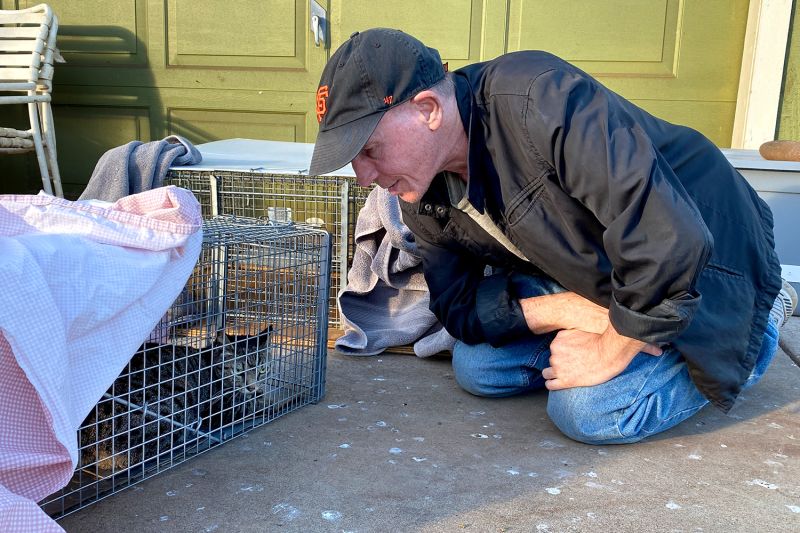
After wildfires scorched the town of Lahaina, Hawaii, in August 2023, Bryan Kortis and Susan Richmond faced one of the biggest challenges of their cat-trapping careers.
In the months following the devastation, the husband-and-wife team coordinated a trapping project that successfully rescued over 600 cats, including community cats and displaced pets, from the burn zone on the northwest coast of Maui.
By mid-February 2024, only about 40 cats remained. But time was running out. Work crews were moving in to remove the burned-out structures and debris.
“We were down to the wariest, trap-savviest cats,” says Richmond, executive director of Neighborhood Cats, which runs trap-neuter-return programs in New York City, Jersey City and Maui. “It became clear they were onto our tricks and would never go into a regular box trap and would avoid a drop trap with a person anywhere nearby, even a trapper holding a remote control trigger a couple hundred feet away.”
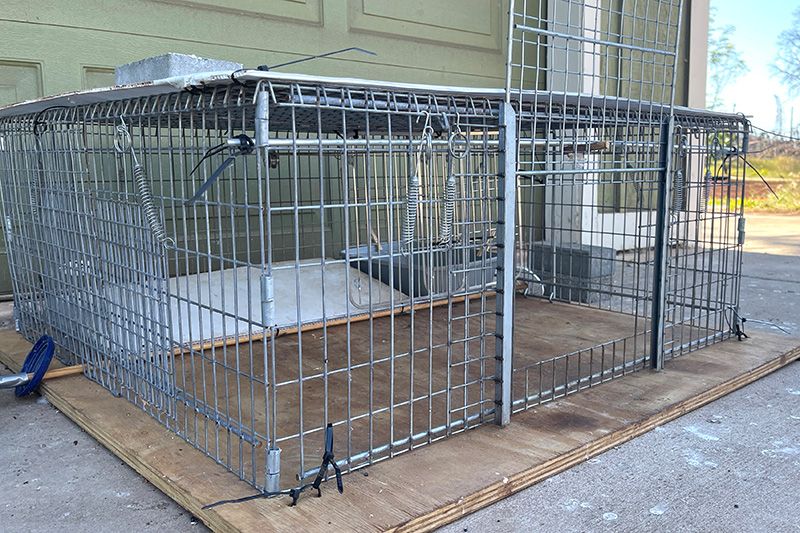
Richmond and Kortis decided they needed a drop trap with a trip plate that would be automatically triggered when a cat ventured inside. Since no company manufactured such a device, they looked for ways to modify their existing equipment.
“We sat around one afternoon determined to figure out how to get the drop trap to close by itself and pieced together what we came up with, then modified it after experience in the field,” says Kortis, national programs director of Neighborhood Cats.
Among their successful captures was a small brown tabby. Kortis and Richmond knew her well. For months they’d watched her on trail cameras, sniffing at the traps they’d set and then moving on.
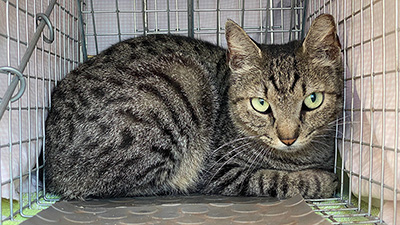
“It was the auto-drop trap that finally got her,” Richmond says. “We expected her to be a fierce warrior, all flattened ears and furious hisses. Instead, she looked up at us and mewed politely, as if to say, ‘What took you so long?’”
When they eventually caught a shy black cat (aka No. 617), every known survivor of the disaster was safe.
Born out of ingenuity and a dose of desperation, the auto-drop trap was a “game changer and a lifesaver,” Kortis says. “It got us out of the burn zone!”
Evolving strategies for TNR
Kortis and Richmond aren’t the only people tapping technology to meet the challenges of TNR. On Community Cats United’s TNR Facebook group, nearly 30,000 members share creative ways to outsmart cats and increase trapping success.
Many describe repurposing commercial gadgets—such as luggage- and key-tracking devices—to monitor trapping equipment and even pinpoint where mom cats have stashed their kittens. There are in-depth discussions on various types of cameras, smartphone apps, and WiFi versus cellular versus GPS technology.
For people outside the TNR world, it might seem strange that people devote so much mental energy to catching cats. But for those who have spent countless days, weeks or even months failing to capture an elusive kitty, the motivation to try something new is high.
With that in mind, we asked some experts to share their latest, tech-enabled strategies. We hope these tips enhance your trapping toolkit and your TNR success!
Using cameras for TNR
Trail cameras (also known as wildlife cameras) have long been a staple of TNR, used for identifying cats in a colony and their routines.
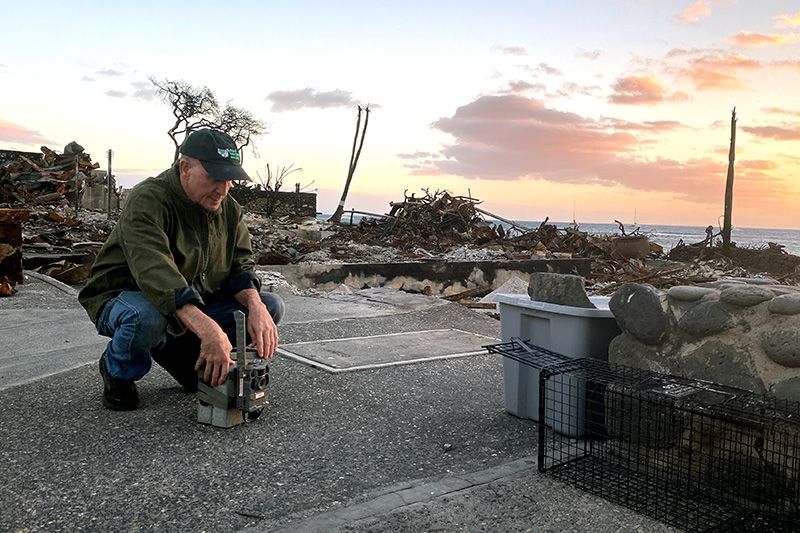
The least expensive models store photos on an SD card, which require trappers to remove the card from the camera and upload the photos to a computer. That’s the type of camera Neighborhood Cats initially used during the Maui wildfire response, but Kortis and Richmond soon realized they needed a higher-tech option for monitoring the more than 80 feeding stations across the burn zone.
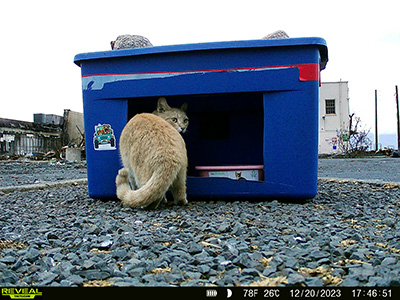
Fortunately, livestream trail cameras have become increasingly affordable. Neighborhood Cats purchased Tactacam brand cellular trail cameras and used the related app to view multiple camera feeds simultaneously (a feature several camera manufacturers now offer).
Compared to the SD-card cameras, the cellular cameras “were much less labor-intensive and allowed real-time monitoring of traps,” Kortis says. They enabled the team to identify cats who were injured and prioritize their trapping, determine which cats ate at which feeding stations and the times they were most likely to appear, and see when cats had been trapped.
As more livestream cameras come on the market, the features continue to expand. Here are some tips to help you find the right camera for your needs:
- Examine the choices. Trail cameras aren’t your only option for cat and trap monitoring. Many TNR advocates are fans of outdoor security cameras. Some models come with solar panels (no need to swap out batteries) and even allow the user to adjust the angle of the camera remotely. Check out online product reviews and feedback in community cat social media groups.
- Check image clarity: Crisp images can be important if you need to distinguish whether cats are ear-tipped. Keep in mind that while some newer cameras provide color photos at night, most use infrared technology in low-light conditions. “So orange cats will look white,” Kortis says, “and you won’t be able to distinguish a gray tabby versus a brown tabby.”
- Connectivity is key: Livestream cameras use either WiFi/Bluetooth or cellular service to transmit images. For WiFi/Bluetooth, you must be within the camera’s signal range to connect. If you want to monitor a camera from far away, cellular is the way to go. However, you’ll need to pay for a data plan (some camera manufacturers offer plans starting at $5 a month). Since some brands work better with certain mobile service providers, research which mobile carrier networks have the strongest signals and widespread service in the areas you’re trapping.
- Speed can count: Some newer model cellular cameras allow for real-time video without the multisecond delay of older models. “This can be a tremendous advantage for a trapper using a remote control,” Kortis says. “It means you don’t have to position yourself so you have eyes on the trap—you can watch your phone instead and know when to pull the trigger. That’s important with spooky cats who you need to hide from so they don’t see you. It also lets the trapper stay at the far end distance-wise of the remote’s range.”
- Choose the right settings. To preserve battery life in trail cameras, “don’t set the camera to record video unless you really need or want video,” Kortis says. “Set the interval between shots (still or video) to at least 10 seconds so the camera is not constantly shooting the same cat over and over. On the better cameras, set the motion sensitivity toward the midrange rather than the most sensitive, or else the camera will trigger every time a blade of grass moves.”
Selectively trapping cats with box traps
Looking for a way to capture a specific cat out of a group using a regular box trap? While remote-control trap trigger devices are available from some manufacturers, they’re not in everyone’s budget. And there are times when the low-tech bottle-and-string method isn’t feasible either.
TNR Utopia in New York was quick to see the possibilities of drone clips, inexpensive gadgets designed to drop small objects from personal flying drones.
Drone clips offer “a highly effective method for selective trapping in complex environments,” says Louis Lotito, the group’s director of communications and community engagement.
“The drone clip allows us to bait and set the trap with a clean, remote line of sight, often from a discreet distance, which minimizes human scent and activity near the trap itself,” he adds. “It provides the crucial ability to wait for the exact moment the target cat is fully inside the trap, which is more difficult to replicate with traditional string-and-bottle setups, particularly in situations with dense foliage or when the trap location is not easily accessible.”
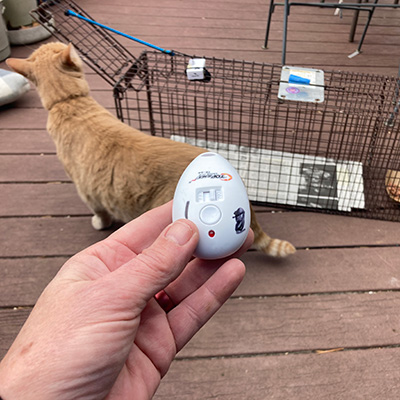
Check out TNR Utopia’s video on how to use drone clips (skim the comments for more useful advice from users). Here are some tips and caveats from Lotito:
- Battery life and preparation: Always start with a new, fully charged battery. In cold weather, battery life diminishes rapidly, so have backup batteries on hand.
- Range and line of sight: The device’s range is generally excellent, but you must maintain a clear line of sight between the remote and the clip. Thick concrete walls, metal structures, or dense, multistory buildings can block the signal. Test the connection with a few mock releases before setting the trap for real.
- Mechanism cleanliness: The clip mechanism must be kept clean and dry. Even small bits of dirt, debris or moisture can cause the clip to stick or not release cleanly when triggered. A quick wipedown before deployment is all you need.
Smartphone strategies for TNR
As smartphones have become ubiquitous, cat advocates have been quick to pounce on their potential uses for TNR.
Some use apps connected to cloud-based databases to access and update colony and cat records in the field. Some TNR groups use scheduling apps, including ones designed for restaurant workers, to coordinate trapping projects and track progress. During the Maui wildfire response, Kortis and Richmond used the WhatsApp messaging app to organize and communicate with more than a dozen trappers and feeders.
Smartphones can also aid trapping by broadcasting sounds that attract cats. Kortis recommends pairing your smartphone with a wireless mini-speaker (about 2 inches tall) to amplify the volume.
“Mini-speakers now come with Bluetooth, so you can avoid putting your pricey phone under, in or on the trap,” he says. “You can put the inexpensive speaker there instead and keep your phone somewhere in range of the speaker but out of range of the cats.”
Here are some videos to start building your playlist:
- “Mom cats are especially attracted to sounds of mewing baby kittens,” Kortis says, “especially if the kittens are missing because you’ve already caught them.” Check out TNR Utopia’s “30 minutes of kittens crying” recording.
- Looking to lure an unneutered tom? Try the sounds of a female cat in heat.
- Trying to catch a frightened kitten who is under a shed or other place you can’t access? Among its trapper tips, Neighborhood Cats states that by playing the mews and chirps of little kittens, “there’s a good chance your little holdout will make a beeline to these other ‘kittens.’”
Smartphones can also aid trapping by broadcasting sounds that attract cats.
Lures that simulate prey or stimulate curiosity
Dave Pauli, global wildlife diversity specialist with Greater Good Charities, has trapped cats around the world for spay/neuter and rescue projects.
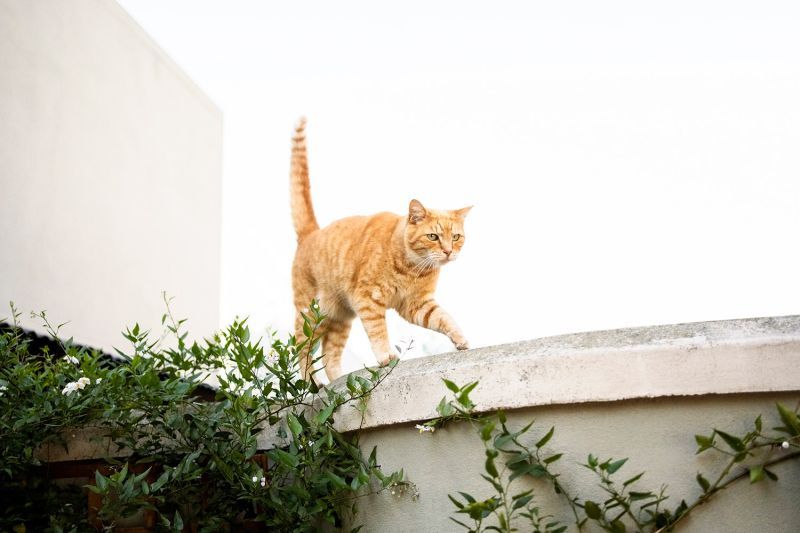
While most cats will enter traps for a tasty food bait, he says, “technology and a little common sense can help catch cats who aren’t primarily motivated by their stomachs.” Combining a food bait with another lure is also a good way to up the ante for a recalcitrant kitty.
Here are Pauli’s tips for using devices that appeal to cats’ hunting instincts:
- “Electronic squeakers are small devices that emit a rodent-like sound. The ‘Kill Squeak’ (what a crappy name) is the cheapest and smallest. It’s also the only one that runs for 10 seconds and then shuts off for 10 seconds, which is really what makes it effective. I put them in a small Pringles can or plastic soap bar storage box (which protects the device from cat teeth and moisture) and either place them in the rear of the trap, behind the trip plate or bury them beneath the rear of the trap.”
- “For rural trapping, I also use a small predator caller (one that simulates the sound of a wounded rabbit) to call cats to the trap site. I only do this when all the traps are set up and I’m preparing to leave the location.”
New TNR tools on the horizon
As technology advances, community cat advocates will continue to find new strategies to make trapping more effective and efficient. Pauli thinks it won’t be long before trappers use personal flying drones to inventory the size and makeup of cat colonies.
Danielle Bays, senior program manager for cat protection and policy at Humane World for Animals, foresees advancements that could revolutionize TNR and how we care for community cats.
“Emerging technologies have the power to really expand access to care for community cats—innovations such as AI-driven health monitoring of community cats at feeding stations, permanent nonsurgical sterilization that can be delivered with a single injection and predictive analytics to guide TNR programs in population management,” she says.
“There are many out-of-the-box thinkers among us who see how new technologies can be applied to help cats,” she adds. “I’m excited to think about how our work will evolve and all the new tools on the horizon.”

Advertisement