How to: Start a pet food pantry
Practical advice for operating a pet food assistance program
Published April 14, 2026
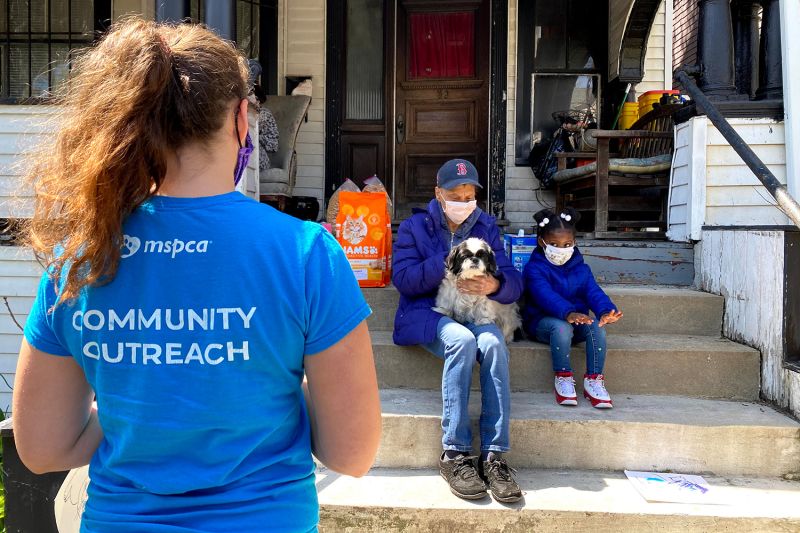
Massachusetts SPCA-Angell didn’t start its pet food assistance program with a five-year plan or a polished operations manual. The program began during the COVID-19 pandemic with some bags of food, which the shelter distributed to the community however it could.
Six years later, MSPCA-Angell serves the Dorchester, Lawrence, Hyannis and Salem communities with roughly 3.5 million pet meals a year.
The lesson? You don’t need a perfect system to begin. You need a starting point. Here are some tips to help you find yours.
The big picture
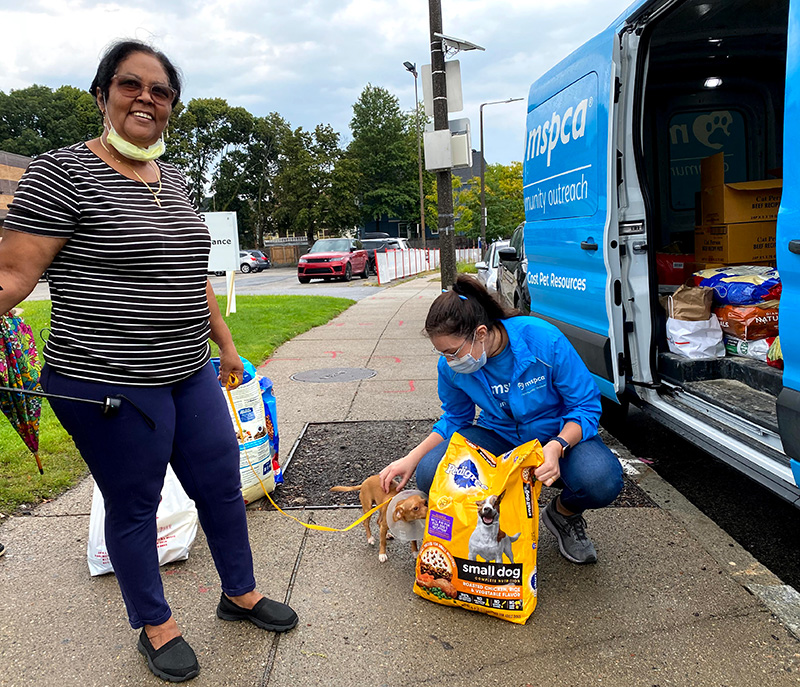
Pet food pantries are a vital resource for a growing number of pet owners and community cat caretakers. Veterinary care, pet food and pet supplies have all risen sharply in cost in recent years, often outpacing overall inflation, while wages and public assistance have remained flat, declined or even disappeared.
“You can’t look at pet food in a silo,” says Amanda Arrington, Humane World for Animals’ vice president of access to care in the United States. “You have to look at all of the expenses someone has every single month, and when all of those increase, there’s less available for their pets.”
And when you consider that 91% of people are willing to put their pets’ needs before their own, according to a 2024 Harris Poll survey, it’s clear that helping animals helps people, too.
Starting a pet food pantry will also help you better connect with your community.
Rick Haaland, community outreach manager for a Pets for Life program serving the Leech Lake Band of Ojibwe in northern Minnesota, says distributing pet food is a “great icebreaker.” Once people feel seen and supported, it’s easier to talk about other available services, such as spay/neuter or veterinary care.
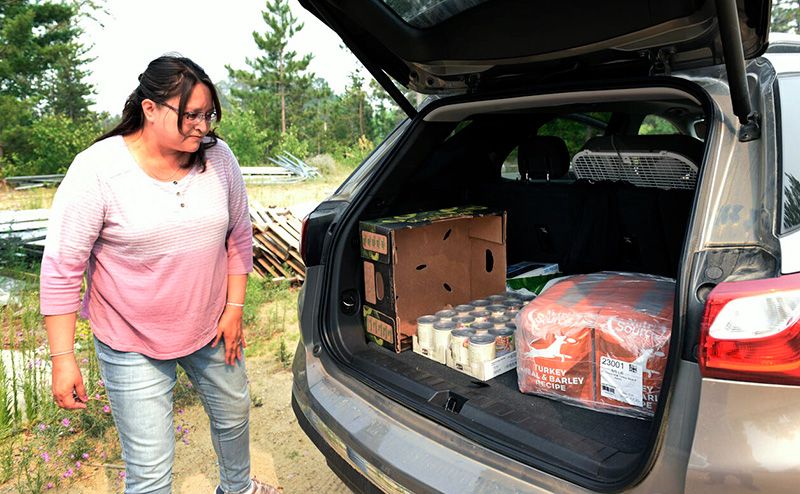
At Haaland’s monthly drive-through giveaways, about 35,000 pounds of pet food goes out the door to more than 200 people in less than two hours—a turnout he credits to the deep trust the program has built over time.
First steps to starting a pet food pantry
Before launching a program, it’s important to do some research.
What types of pets are most common in your community, and are there specific food needs (such as large-breed kibble or cat food) that aren’t being met? Where are the highest concentrations of need? Can families walk to you, or would they have to travel miles? What are the possible barriers to people accessing your services?
Haaland times his monthly drive-through pet food distributions late in the day. “That way when people get off work, they still have time to get there,” he says.
At MSPCA-Angell, staff and volunteers set up mobile pop-up pantries in target neighborhoods, deliver pet food and supplies to human food pantries, and offer support at all four of the shelter’s adoption centers. In short, they meet people wherever they already are.
Serving different areas requires flexibility, says MSPCA-Angell community outreach director Alyssa Krieger. At some locations, Krieger and her team distribute pet food twice a week because clients can walk over; at others, they hand out larger quantities monthly because people are driving long distances.
TIP: “What works at one site may not work at another,” Krieger says. “At one location, we might distribute food per pet, and at another, it might make more sense to provide a set amount per family. It really depends on the community you’re serving.”
Start small
Haaland remembers bagging food in a garage before he had a dedicated space, and NaCole Torrez’s first office for Altus Pets for Life in Oklahoma was her 2001 Ford Ranger.
“I was just working out of my truck, loading up treats, food, litter—a little bit of everything—and going door to door,” Torrez says of when the program started in 2019. When she secured a tiny 15-by-15-foot room a few years later, she added shelves and slowly expanded inventory.
The Pets for Life program became part of the Southwest Oklahoma Community Action Group in 2024, and now she has an office, a larger dedicated pantry space, and an additional staff member to help serve the towns of Altus, Hollis and Olustee. Together with the support of about 60 volunteers, the program offers pet food support through in-person office hours, twice-monthly porch deliveries for clients unable to travel and occasional events.
It doesn’t have to be a “seven-day-a-week, full-service pet pantry,” Arrington says. Growth can be gradual, and even keeping a few bags of food handy for when someone calls in a crisis makes a difference.
TIP: Break large bags of food into smaller portions to reach more families. “If I have a pallet of 50 bags, I’m only reaching 50 families,” Torrez says. “If we break it down, we can reach 100.” During a government shutdown that hit her military-base community hard, Torrez’s team used this approach to distribute roughly 10,000 pounds of food in a single month.
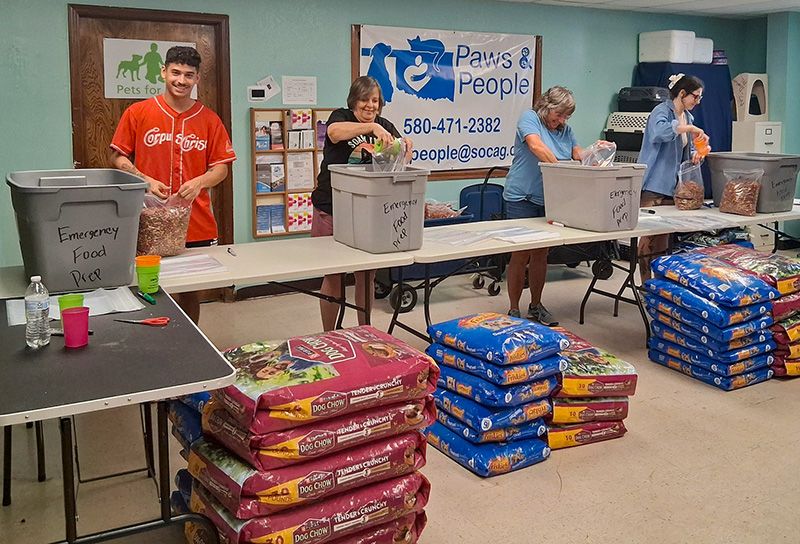
It’s OK to stay small
Not every pet pantry needs a building—or even regular hours. Some programs use outdoor, community-supported boxes (often called blessing boxes), which operate on a self-serve model and a simple concept: Take what you need; leave what you can.
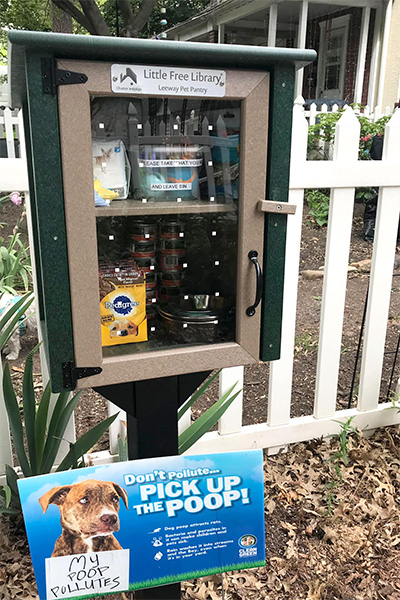
Leeway Pet Pantry sits outside the home of Lindsay Jacks in Dundalk, Maryland. To spread the word, Jacks posts photos of what she has in stock on Instagram, along with an Amazon wish list of items people can donate directly.
Being small has its perks. “You get to know certain people that are your regulars, which is great for me, because I can help provide them with the exact food that their pet has,” Jacks told the Dundalk Eagle last year.
In Oklahoma, Torrez also provides support through five neighborhood blessing boxes regularly restocked with human and pet food by the Southwest Oklahoma Community Action Group’s Southwest Enterprises program, a support service for people with developmental disabilities. She recently added five more communities to her service area, with two new blessing boxes installed in early 2025.
TIP: Running low on supplies? Post a pic of empty shelves to encourage donations. Shelters say this approach generates a stronger response than cute animal pics.
Running low on supplies? Post a pic of empty shelves to encourage donations.
Build partnerships thoughtfully
Strong partnerships, like the one Torrez has with Southwest Enterprises, can stretch limited resources and help you reach more families. Shelters can team up with food banks, churches or other human service organizations to provide more holistic support.
Arrington suggests approaching potential partners with something meaningful to offer.
“You have to be thoughtful about how you show up,” she says, as other organizations are stretched thin, too. Bringing supplies or logistical support to the table can build stronger relationships than simply asking for help.
MSPCA-Angell expanded its partner network in 2020, when the pandemic made it dangerous for people to visit multiple locations. The team began dropping off pet food at human food pantries, a model that helps reach families in neighborhoods without a pop-up pantry.
Other collaborations to consider:
- Reach out to grocery stores, big-box retailers or warehouses to ask about damaged inventory that can’t be sold but is still safe for pets.
- Invite student groups or corporate teams to help break down bags or manage distribution days.
- Ask businesses to donate food storage containers.
TIP: Definitely consider where you’ll store your food supply. MSPCA-Angell learned the hard way that bags left outside airtight containers make tasty treats for rodents and other wildlife. Shipping containers are relatively inexpensive and keep large pallets of food secure.
Decide your limits, and stick to them
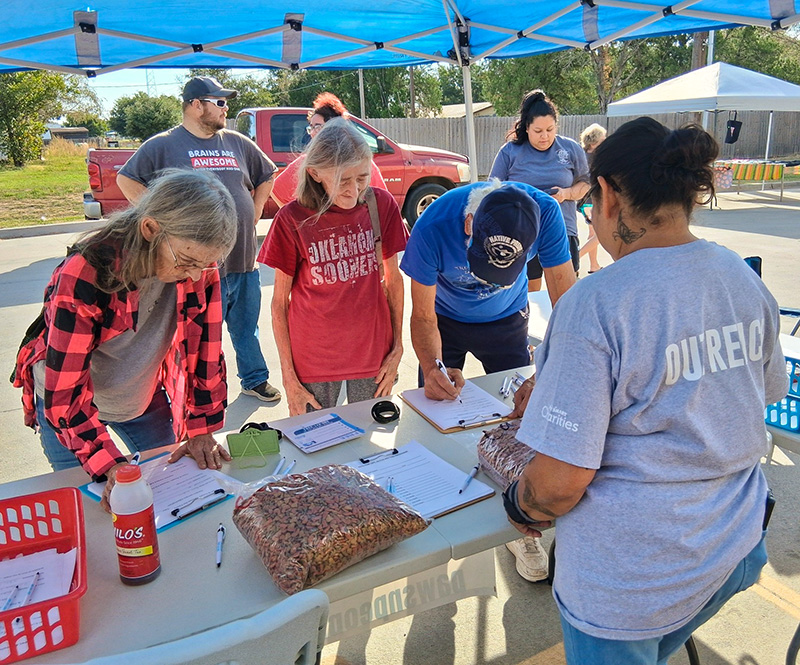
Consider the amount of pet food each person will receive. Is it per pet or per family? Communicate your guidelines clearly and often.
Krieger’s team posts distribution amounts (such as five pounds of food per pet) at community events so they’re easy for everyone to reference.
“When it’s in writing and we point to it, it’s a little bit easier for people,” Krieger says. “This is the system we’ve worked out so that everybody can get something.”
Predictability reduces chaos for staff and clients alike. When people know what to expect, and see that the rules apply evenly, you earn their trust.
TIP: Depending on your capacity and local demand, you may not be able to cover your clients’ entire pet food needs. If that’s the case, help manage expectations by letting clients know that you can only offer supplemental pet food support, not a permanent full supply, or that amounts distributed may vary based on donations.
Be willing to adapt
Listen for feedback. Maybe distribution hours aren’t convenient or the process is unclear.
No model works perfectly forever, Krieger says. If a process feels frustrating (for your staff, volunteers or the people you serve), it’s time to reassess.
In Oklahoma, Torrez shifted from “come anytime” to a sprint model to protect her team’s capacity. After years of trying to always be available, she and her team operate their onsite pantry Monday through Wednesday, from 9 a.m. to noon. Her colleague covers a second community about 40 miles away, Wednesday through Friday.
“Having set hours helps people know exactly when we’re open, and it helps us manage our time,” she says.
TIP: Offer a printed survey or a QR code to an online feedback form to hear from your clients. This is how MSPCA-Angell got the idea to give seniors early access so they don’t stand in line.
Offer a printed survey or a QR code to an online feedback form to hear from your clients.
Lean on your volunteers
A handful of committed volunteers can expand what type of pet food support you’re able to provide.
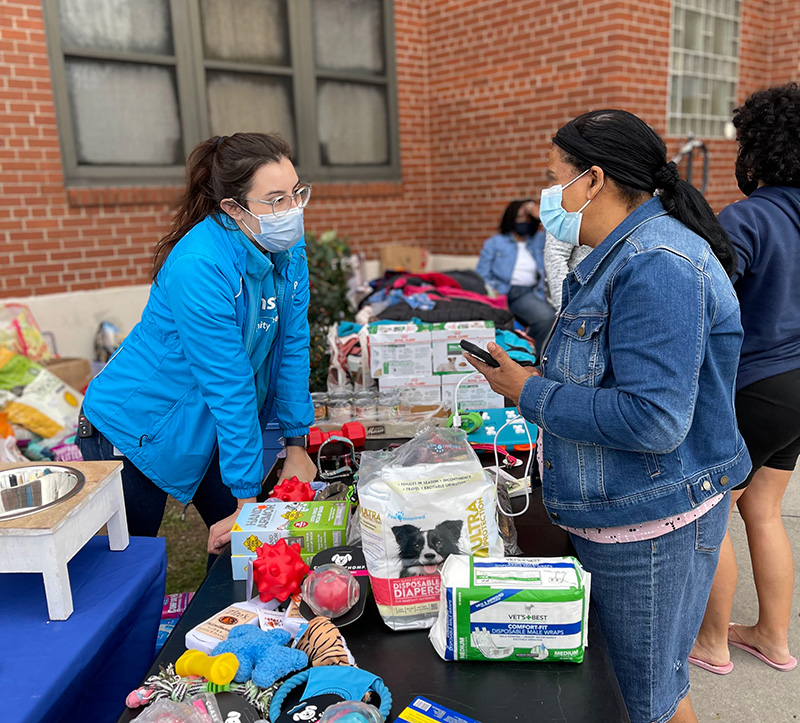
MSPCA-Angell recruits volunteers through its website and encourages schools and civic organizations to organize supply drives.
“There’s no parts of the food pantry programs that aren’t touched by or even sometimes entirely run by volunteers,” says Krieger. That includes organizing donations in-house, repackaging large bags into smaller portions, delivering food to clients and partner pantries, requesting food donations and picking up supplies.
Torrez’s big distribution events (think 50 tons of food handed out to a line of folks wrapped around a building) rely on about 60 volunteers, a sharp contrast to her day-to-day operation, which for years she managed entirely alone. She recruits largely through word of mouth and community relationships, noting that “neighbors talking to neighbors” is how she gets such great volunteer support.
On the Leech Lake Reservation, Haaland’s program runs on a small, dependable crew that knows the community well: essentially himself, two staff members and two regular volunteers, with five or six additional community members who show up on distribution days.
“They stick to the rules and provide support” so he can focus on managing other areas of outreach, he says. “It works out great.”
Accept that you can’t solve everything
The need far exceeds the supply, and it keeps growing.
In late 2025, cuts to the federal food assistance program increased the number of pet meals MSPCA-Angell provided from a typical 250,000 to more than 400,000 in November alone.
“We’re already operating in some of the communities hit hardest,” Krieger said in a press release at the time, “but ramping up to meet this increased need puts a significant strain on our resources and staff.”
Torrez and her team have experienced similar pressures. During a government shutdown affecting military families in their region, they distributed roughly 10,000 pounds of food in one month. It was nearly double their usual output—and still not enough.
Even on the hardest days, though, “it’s very rewarding to be able to provide to people who need it most,” Torrez says, “and to know they trust me enough to come to me.”

Advertisement